
by Tijs Besieux, PhD
I use 12 data-collection methods to assess customer-centric leadership and its root causes. Here’s why, and how.
I built Cleo Felix because I strongly believe that leadership is a powerful lever for creating and capturing customer value over the long term.
And to help organizations enable customer-centric leadership, we need to start by accurately measuring two things: (1) customer-centric leadership itself, and (2) the factors that shape it. Because if we don’t know what drives that behavior, it becomes anyone’s guess to envision and implement solutions that make customer-centric leadership as frictionless as possible.
In a simple world, we could walk up to any leader and ask: “How customer-centric are you, and what’s keeping you from taking the next step?”
As it turns out, reality is a bit more complex. The reason? We’re not that good at self-assessment, let alone at pinpointing the factors that shape our behavior. I once interviewed a leader who scored well below average on a 360 feedback survey on customer-centric leadership. But when I asked him for a 1-10 self-assessment, he confidently put himself in the 9/10 ballpark. He explained it all came down to discipline. This is where overconfidence bias (the 9/10 self-assessment), or perhaps a desire to protect one’s ego, and the fallacy of the single cause (boiling it all down to discipline) come into play. Together, they paint a picture that may not resemble reality. From research, we know that behavior is shaped by three major sources: capability, motivation, and the environment in which we operate. Specifically for customer-centric leadership, I developed a framework to capture its root causes.
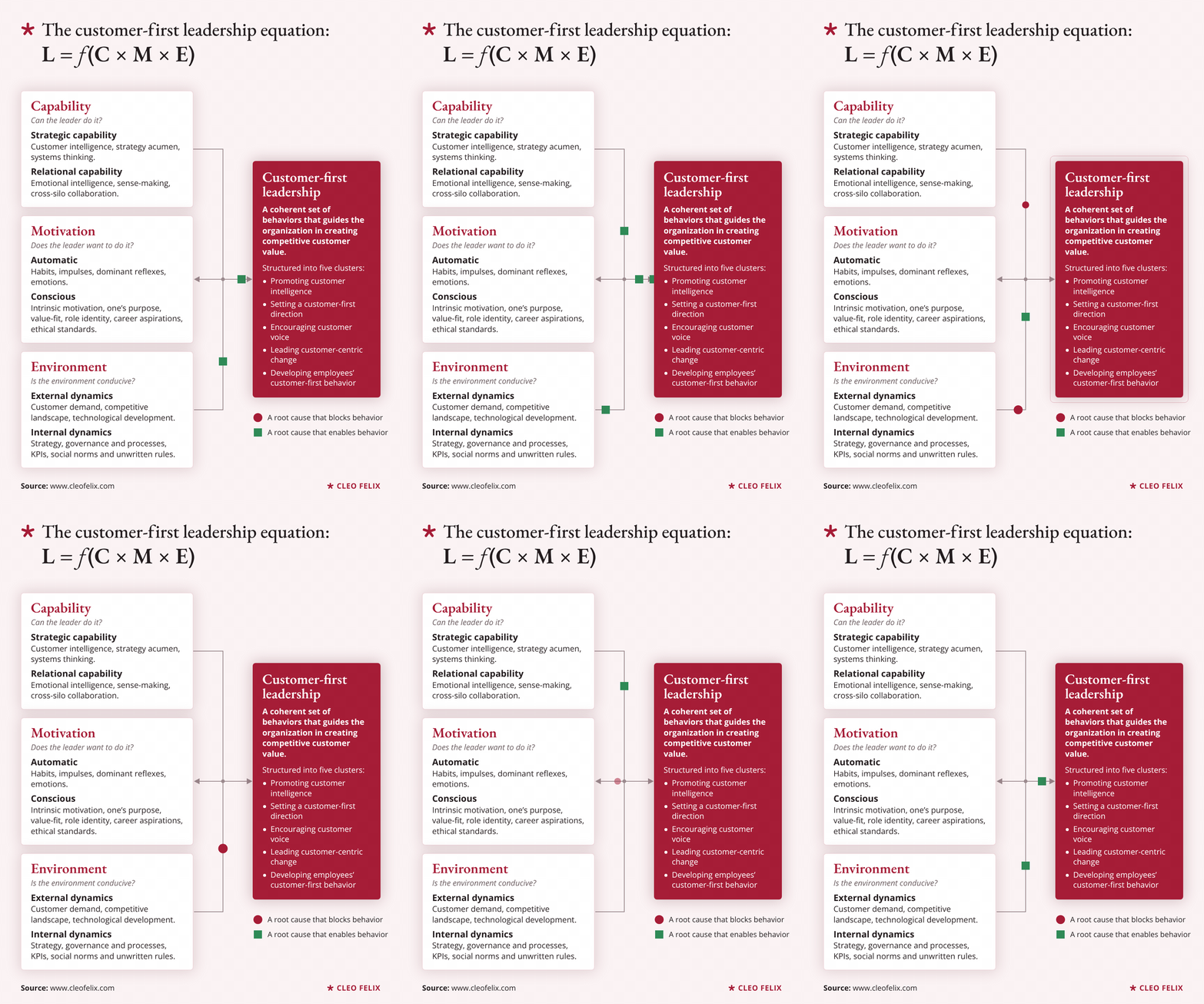
In short, on average, our brains are not wired to conduct an assessment as objective as possible of our performance in a specific area. The same goes for the factors contributing to that performance. Tons of biases, blind spots, and personal beliefs come into play. They potentially override the actual dynamics shaping our behavior and its root causes.
A second reason I use a more elaborate approach has to do with what the data gathering is intended to achieve: change. The assessment itself is never the goal. It's a means for an organization to know where it stands today, and which factors to work on to close the gap with the leadership it aspires to.
And here's something people often miss. Gathering the data isn't a step before the change. It's already one of the first steps of the change itself. I see three reasons for that, and they kind of cluster together.
The first is that it sends a signal. If, as an organization, you decide to gather data on a topic from multiple sources, you're saying you value it. You wouldn't invest that time and energy if it weren't a strategic priority. And because the grapevine goes fast, that signal travels through the entire organization. Customer-centric leadership is something we take seriously. We know that tone from the top is important in shaping culture. It's by no means the only thing, but this is already a first signal.
The second is that it gets people thinking. When you ask so many people so many questions, and you observe so many teams, they become highly aware that customer-centric leadership matters. Those questions and observations will, implicitly or explicitly, trigger some reflection. Say I schedule a 45-minute conversation with a senior leader, and I tell them we're here to talk about customer-centric leadership. Before, during, or after that interview, it will undoubtedly get them thinking. Aha, so this is something the organization clearly finds important. They may have their own point of view. Maybe they align, maybe they don't. But it gets them thinking about how they currently behave in line with that North Star and their roles as leaders and role models.
The third is that you learn early where the biggest gaps sit. Because you gather so many different sources, you quickly get a good understanding of where things fall short. That could be in leadership behavior itself, or in one of the three big buckets that shape it: capability, motivation, and the environment. You see it either through reported data or by firsthand observation. And where you find the biggest gaps, you also find the opportunity for meaningful change. Having that early on is so valuable. When you sit with your sponsors and the leaders you work with, you already have meaningful insights from day one of data collection. You can start working on prototype solutions to address the friction, hurdles, and roadblocks that keep leaders from advancing to the next level of customer-centric leadership.
On top of that, leaders are more likely to change their behavior when they receive a strong signal from a trusted source about their performance. That's especially true when it clashes with how they see themselves. And it's probably not a very appealing change narrative to say, "Look, the company's leaders took a hard look at themselves and decided to implement these and such changes." Research and my personal experience show that successful change rides the waves of a sound analysis that key stakeholders can identify with. So, from a change perspective, it's better to take an as-objective-as-possible approach to assess where leaders stand today and the obstacles to remove so they can collectively improve tomorrow.
That brings us to the question of how.
Being a consultant for 16 years has rewired my brain to try and explain the world in 2x2 matrices. One 2x2 is more useful than another. But this time, I found it very helpful to plot a range of data-gathering techniques on a 2x2 grid that is specifically suited to the context of customer-centric leadership behavior.
Specifically, I defined two dimensions:
1. Point of view: inside-out, or outside-in. I collect data from both inside and outside the organization. Specifically, in the context of customer-centric leadership, the external environment can influence leaders' behavior directly and indirectly.
2. Type of data: reported or observed. Reported data is all about others telling me what they think, feel, saw, or what happened. It doesn't matter whether they do so by telling me in an interview or through written reports. Observed data is what I see myself, so it is a more direct way of data gathering.
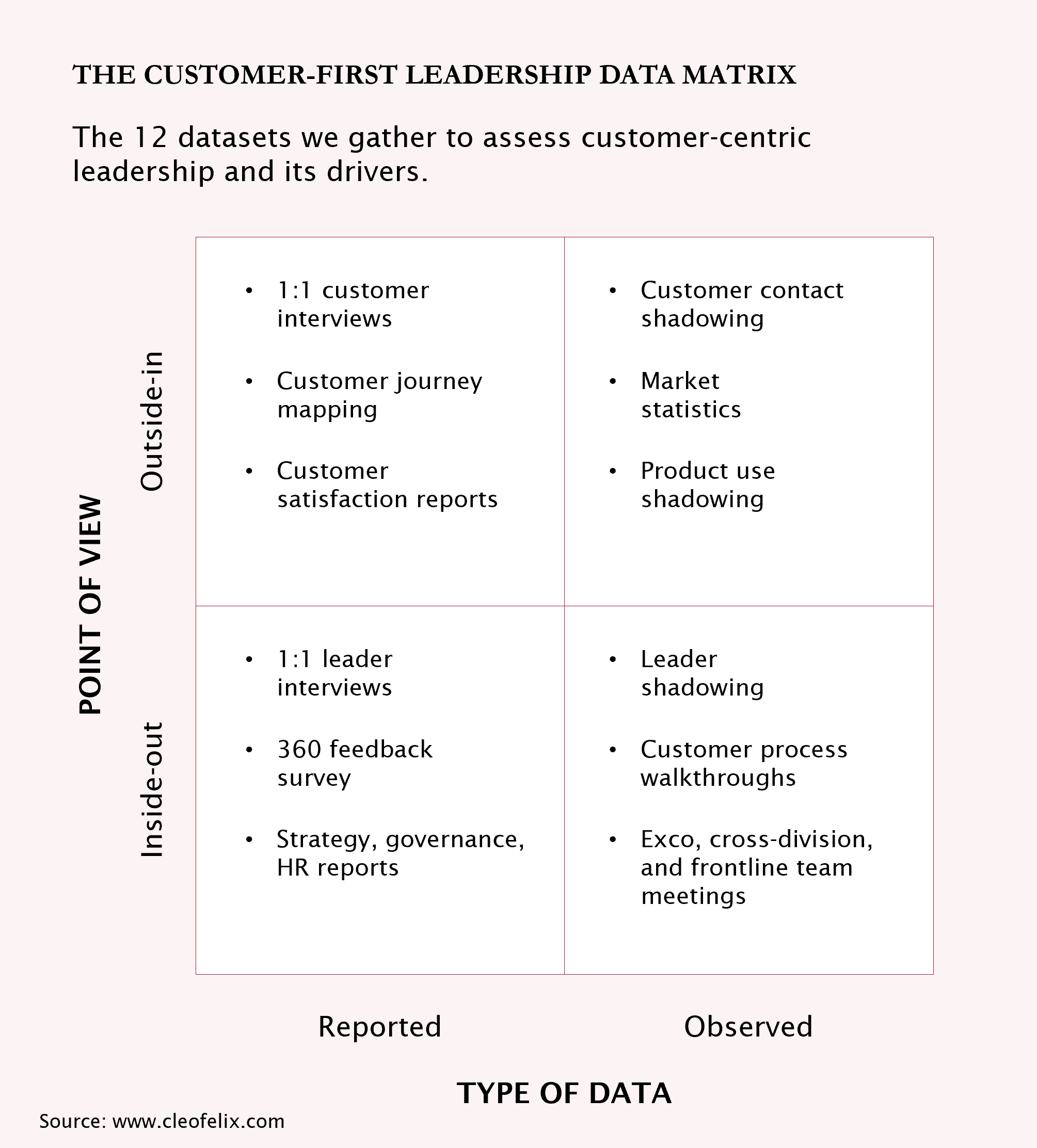
At this point, I think it’s worth noting that you cannot say one dataset is better than the other. The whole point is that by collecting different data sets, we gain a richer, deeper understanding of what’s going on. That way, we can act with greater confidence and precision when addressing the obstacles at hand. In the scientific community, we call this “data triangulation.”
In what follows, I’ll explain the why and how of the different data sets, along with practical examples from my own experience when relevant.
Reported, inside-out data
Let's start with the data I gather from within the organization. For reported data, I mainly use three datasets. There are one-on-one leader interviews, a 360 feedback survey, and a whole bunch of documentation on strategy, governance, and HR.
1:1 leader interviews
In these interviews, my main goal is to get leaders to answer at least three questions.
The first is how they define customer-centricity, or customer-centric leadership. What's their working definition? I ask this because if you want to become more customer-centric as an organization and position leadership as the lever to guide you there, your leaders need a shared definition. And it needs to be usable and feasible.
Interestingly, I've learned over time that these definitions can wildly differ. Very often they also lack a crucial ingredient, with the result that customer centricity as a concept becomes rather useless.
Customer centricity is really about two things. It's about the capability to define who your valuable customers are. And then it's about acting to address their desires and needs. What I often hear in interviews is that leaders skip that first part and go straight to the second. "We have a bunch of customers, and when we're customer-centric, we aim to serve them to the best of our ability." That's not wrong. It's just missing a vital ingredient.
In fact, the starting point for many organizations is that they don't have a clear view of who their valuable customers actually are. As a result, they invest a lot of time and resources serving customers, yet they can't capture the value they create. And because leaders interpret customer centricity so differently, they also describe behaving very differently when they advocate for it inside the organization.
Here's an example. I worked for a client in the insurance industry. When I asked about customers, it was quite interesting that one leader said their customer was the broker. The company made insurance products, which were then distributed through brokers. Someone else said the customer was the end user, the person who uses the insurance policy.
On paper, this may seem like a nuance. In an FMCG world, it's basically the difference between the customer and the consumer. But here it makes quite a stark difference, because when you optimize for the broker, you're not necessarily optimizing for the person who uses the insurance. So if you use the word customer to refer to both brokers and end users, and you're not aware that you're using different versions of the same concept, it becomes really difficult to align a company towards customer value. First, you need that shared definition. This is something I was able to unearth from the one-on-one leader interviews.
The second thing I want to understand is everything leaders run into when they try to advance customer-centricity. What's the friction? What are the hurdles? What issues come up when they try to lead their organization with the customer in mind? I'll ask several questions to go deeper on that. Often this is the part of the interview where leaders feel free to vent a little. It's also where they attribute much of what doesn't run as smoothly as it could to factors outside themselves.
Then I move on to a third set of questions to understand how they lead day to day. According to them, what does effective leadership look like? How do they make decisions, and based on what criteria? How do they develop their teams and their people, and based on what insights? These questions help me compare their narrative of how they lead with what we commonly understand as the behaviors that define customer-centric leadership.
The interviews usually take 45 minutes to an hour. When I work with a cohort of 50 leaders, I try to interview at least 15 of them. That way I know I have a solid representation of the group I'll be working with.
This is where the point I made at the start becomes very concrete. Gathering data is already an intervention. What you ask about in an interview, what you listen to, what you treat as worth understanding: all of that already sends a strong signal inside the organization.
360 feedback survey
Also in the bucket of reported, inside-out data is the 360 feedback survey. As part of the Cleo Felix program, every leader in the cohort, usually the top 50, receives a 360 feedback survey. It measures how the people around them perceive their day-to-day customer-centric leadership behavior.
We built the survey around five behavioral clusters, with three behaviors per cluster. So that's 15 behavioral markers in total, which, taken together, really make up customer-centric leadership. We also added open-ended questions to go one level deeper. There, we invite people to explain why they give a leader the scores they do.
The scale isn't the usual "disagree to agree." It's a frequency scale. Research shows that what matters most in leadership is consistency. Do these customer-centric behaviors really become leadership habits, yes or no? So we ask people how often they see a behavior with a leader. Is it something they rarely see with them, or something they see all the time?
There are two reasons why we include the 360. The first is for the organization as a whole. If we look at our top leadership, where do we stand overall? Are we fairly united in how we score on customer-centric leadership, or is there considerable variation, with leaders scoring very differently from one another? Do we see differences across the organization? For instance, leaders in enabling functions like HR or legal may score lower, while leaders who work daily with customer-facing teams may score higher. All of this is really important to know if you want to figure out where to target your interventions.
The second reason is, for me at least, perhaps even more important. There's plenty of research out there, and it lines up with research I've conducted myself. It shows that leaders need a very powerful signal to change their behavior. And that signal needs to come from a source they find relevant and trust. When you work in a 360 fashion, you increase the chance that at least someone they truly value will have something to say to them.
For leaders to change their behavior, something needs to happen in their motivation, which is one of the root causes of behavior. When leaders get a strong signal from a trustworthy source, it holds up a mirror. It can show a gap between who they want to be as a leader and how their environment perceives them. If that gap is big, it creates a mix of excitement and anxiety, as well as an eagerness to develop and change. And if they then get enough time to reflect on the data, and they recognize the gap, those leaders become very willing to change.
Here's a typical example. In the 360, leaders also rate themselves, and you'll often see at least some discrepancy between how they see themselves and how the people around them see them. What leaders find very powerful, and sometimes very painful, is when they realize their own team sees them trying to be customer-centric. At the same time, their peers across the value chain and their superiors don't see that behavior at all. Or sometimes it's the other way around. They become aware that they behave differently in a meeting with peers than they do with their boss or their own team. And as a result, they're perceived differently. That's the kind of signal that makes leaders want to hone how they show up at work, so it's more aligned with the leader they ultimately want to be in service of the company's customers.
Strategy, governance and HR reports
The third inside-out, reported dataset is everything the company puts on paper. You could call it the organization's espoused theory of how it all works.
So I study plenty of strategy documents, whether that's long-term strategy or annual goal-setting plans like OKRs or OGSMs, you name it. I study the company's governance. Who gets a say in what? What's the org model? And I study HR reports and HR strategy documents to understand the entire performance management cycle.
Why go through all of this? Because it tells you quite a lot about the environment in which leaders operate. Think of it as the formal environment, everything about the company you can put on paper.
Let me give a few examples of what I've learned from these documents.
At one client, the strategy documents clearly emphasized customer intimacy as a core pillar. But when I looked at the HR mechanics and how their recruitment process worked, I learned that the same company hired salespeople quite aggressively with a sales orientation rather than a customer orientation. Those are typically people who are used to, and motivated by, pushing as many products as they can and selling in volume. That's not illegal, and there's nothing wrong with wanting to sell your products. But it goes against the grain of customer-centricity, where the starting point isn't how many products we can sell. The starting point is understanding our customers' needs and desires, and tailoring solutions to meet them. That's very different. Research also shows that a sales focus is more related to unethical behavior, for instance.
So when we found that their recruitment and selection process, including the assessment centers for new leaders, leaned so strongly toward a product-sales focus, we could pinpoint it as a likely root cause. It was pulling leaders away from their customers' long-term needs and desires.
Strategy documents typically give us a much better feel for where the customer sits inside the organization. One thing I'll do first is a very simple cross-check. I scan all the documents to see how often they mention the word "customer" or "client". It's no scientifically rooted metric, of course, but it already gives you an interesting first peek.
Beyond that, we go much deeper, to see if there's a coherent narrative. Here I like to use A.G. Lafley and Roger Martin's Playing to Win. It starts with your winning aspiration, or in other words, what makes you relevant to which customers. Then, to get to that position or keep it, where do you play and how do you win? What core capabilities are you building, and what management systems keep it all working seamlessly? So in these documents we look very deliberately at whether the organization has a clear, working hypothesis about the value it aims to deliver to its customers. And then whether it's actually taking the measures and implementing the strategy to deliver that value.
Of course, a strategy on paper won't decide whether your leaders behave in a customer-centric way. But when your strategy drifts away from customer-centricity, you know it will be a big factor pulling leaders away from customer-centric leadership.
Reported, outside-in data
The second quadrant looks from the outside in. This is data I gather from sources outside the organization, but it's still reported data. Here I'll typically focus on three datasets. There are one-on-one interviews with customers, and there's customer journey mapping. And then there's all the data on customer satisfaction, in the broadest sense possible.
1:1 customer interviews
The first one is really important: sitting down one-on-one with customers. I do this because written customer satisfaction reports only tell you so much about what's going on. Really sitting with customers to understand their perceptions and points of view is extremely valuable.
These are typically 45-minute to 1-hour conversations. I try to understand what it's like, from the customer's perspective, to work with the company. I'll talk to customers who decided to take their business elsewhere, for whatever reason. And of course I talk to customers who are still with the company, whether they're key accounts or mid- or low-tier customers. That way I get a sense of these customers across the board. I usually speak with 10 to 15 customers. That could be more on the B2C side, but I mostly work in B2B. I also segment by how long they've been a customer. Were they recently onboarded, are they somewhere halfway, or have they been a customer for a long time?
In those conversations, I'm looking for their point of view. What's it like to be a customer of this company? What frustrates them, and why? What do they appreciate, and how so? And how do they generally look at this company?
One interview stands out. It was for a telco operator in the B2B space, and I was talking to one of their key accounts, a really big organization. He was quite candid from the start. "If I look at all the suppliers we have, this telco probably rates worst of them all. The only reason we're not breaking the contract is that we'd have to pay a substantial sum to get out of it."
That's something you won't read in any customer satisfaction report. But if you're able to play it back to the company, and especially to senior leadership, that's what I mean when I talk about a very powerful signal. These interviews give you a close, first-person view of what it's like to have this company as your supplier.
Customer journey mapping
The second thing I'll do is customer journey mapping. But keep in mind, this is customer journey mapping from the customer's perspective.
When you ask a company for its customer journey map, which I also do, they'll often show you a visualization of the ideal journey, maybe per customer segment. That's interesting and important to know. But I think it's equally important, and sometimes more important, to ask a few customers. Give them a piece of paper and a pen, and ask them to write down all the steps to becoming a customer of this company. Really from the starting point. The contract you receive, what you do when you call them with a question. Show me the mechanics of that journey through your lens.
So I'll typically ask at least five customers to draw that map from their point of view. At some point in the program, it's then quite interesting to contrast it with the espoused map, the journey as the company thinks it looks.
One example comes from a chemical company. They had defined a specific customer segment for their specialty chemicals and drawn a beautiful seven-step map that made so much sense on paper. Then I asked a customer to draw the map. It immediately became clear that, even before any contract was signed, they had already listed seven or eight steps. I started to understand there was a really substantial gap. On one side was the seamlessness the company thought it had built into its customer journey. On the other hand, there were the nuances and the many frustrations that customers, in fact, experienced.
I might also play back insights from customer interviews and journey maps at an abstract level during one-on-one interviews with leaders. For instance, I could ask a leader how satisfied they think the company's customers are. What do they think it's like for customers to work with them? If a bunch of leaders tell you a story that greatly differs from how customers see it, then you know there's something to work on in leader capability. Leaders need help getting closer to the customer's point of view, and to the truth as the customer sees it.
Customer satisfaction reports
The third outside-in, reported dataset is reports on customer satisfaction. That's everything available. Think of industry reports, NPS scores collected, customer complaints logged, and customer satisfaction surveys sent. It's all the things on paper that help me analyze how specific customers, or segments and groups of customers, think and feel about the company.
This kind of information is really useful to give leaders a level playing field. What are we up against? What's the shape of our organization today in terms of customer centricity?
Some people might say, "We're doing good, our customers are happy." But then you play back the customer interviews, the journey maps, and the satisfaction reports, in a synthesized way, with those powerful signals. And maybe leaders say, "Thinking of it, maybe we're not doing as well as we thought." Or maybe they find they're doing better than they thought. Either way, from that vantage point, you can ask what a meaningful step up would be to better serve the customers who matter to you.
All of this data taken together is interesting to contrast with how leaders think the organization is doing. That tells us quite a bit about leader capability, which is one of the root causes. But this type of data also serves us well throughout the entire program. It tells us what hill we're up against. Is it a steep hill? Are we on track? Or do we need to look in the mirror and say there's still quite a bit of work to be done?
Observed, outside-in data
Now let's go to the datasets that come from observed data. The big difference with reported data is this. The reported data is about people telling me or writing down on paper how they perceive things or how they think things are. Observed data is where I, as a researcher, see things for myself.
And again, we differentiate between data from inside the organization, so everything about its internal workings, and outside-in data. That's data from stakeholders outside the organization, with the customer as the primary external stakeholder in the work we do.
Let's start with observed, outside-in datasets. Here, we shadow customers as they interact with the company, study market statistics, and observe how customers actually use the company's products.
Customer contact shadowing
Customer shadowing is quite simple. We follow specific customers as they interact with the company. That goes all the way from how they send an email or pick up the phone to reach out, to stepping into the store or the company's office for an appointment. We really like to observe firsthand what it's like being a customer of the company.
In one-on-one customer interviews, customers tell us what they like and don't like, and why. Here, we get to see it for ourselves, as we shadow those customers in their contact with the company.
Market statistics
A second dataset here is market statistics. These are facts and figures produced objectively, neither by the company itself nor by its customers. It's external data on market dynamics. I count this as observed data, even though it comes in reports. It's not what a person thinks is happening. It's factual market data, such as the company's market share, the number of competitors, the number of customer segments, and market development. From them, we learn about the competitive and regulatory landscapes, the market's history and evolution, and the technological advancements underway. All of that tells us more about where the company sits. It helps us understand how they position themselves in the market and how they aim to approach customers in it.
One interesting example comes from research we did on customer-centric leadership for a financial institution. They had offices in Europe and offices in the US. And as much as possible, those offices were copy-pasted from one another, with a few cultural nuances. They operated in the same way. They had the same internal strategy, governance, HR setup, and org model. They recruited the same type of people, and the culture and climate were highly similar. The only real difference was that one group of offices was in Europe and the other was in the US, specifically in Boston and New York.
From market statistics and, of course, by speaking with and observing leaders, we learned that competition in Boston and New York was much more cutthroat. For a financial institution to not only thrive but survive, it was way more difficult there than in Europe. The market statistics, and what we heard and saw from leaders, pointed in the same direction.
Interestingly, we found that, as a result of that dynamic, people in sales, in particular, moved much more aggressively. And leaders encouraged that behavior, because they had a narrative that went like this. "In this cutthroat environment, we need to survive. And surviving means we get to the customers first, and we push our products first."
By studying these market statistics and sharing them with leaders and employees, we gained a deeper understanding. The main difference between the two subsidiaries was the market they were in. And that market really shaped the climate in the organization and the behavior we saw across different teams and divisions.
Product use shadowing
The third dataset is from observations of customers using the company's products and services. If it's a software provider, I'll ask a customer to show me how they use the software. If it's a telco provider, I'll go to one of their customers and ask them to show me how they use their telco products.
I gather this data because, unfortunately, companies quite often don't really know how their customers use their products. They have an idea in mind of how it should be used, but not how it's actually being used. And if you don't know that, it's really difficult to decide what to look at in the next iteration or generation of your product, and in the features you offer, to make the customer experience even better.
Here's one example. When I worked for a dredging company, I observed their potential customers. So not even their customers yet. I observed them at the very start of a potential collaboration, when they received the company's tender. I asked them to show me what they do with it once it lands.
What I learned quite instantly is that the tender didn't work the way the company thought it did. The dredging company sent a file that was basically a bunch of Excel files, but it lacked an overarching point of view. The people who put the tender together thought it was very user-friendly. They thought it made a lot of sense and would lead procurement to the right places. In reality, the potential customer would open it and immediately miss a few tabs in the Excel file. They didn't get the big picture, and they often missed vital pieces. So there was always an initial loop of frustration, where potential customers had to come back with follow-up questions.
The company didn't really learn from that until I was allowed to videotape a potential customer as they studied the tender. Suddenly, people in management said, "Can you believe this? They completely missed this tab in our Excel file. They completely missed this paragraph, because it was buried somewhere else." They realized they weren't giving their company a chance to shine, or to address the topics they wanted to.
Observed, inside-out data
The fourth type of dataset comes from observing leaders and employees inside the organization. From the reported data, such as the interviews, the 360 feedback survey, and the strategy documents, we get a sense of the espoused part of things. That's what people say and put on paper about how they perceive things, or how they think things should work. Here, we get to see for ourselves how it actually plays out.
That also lets us establish whether there's a big dissonance between what people say and how things unfold in day-to-day practice. There's no judgment in that. It's just interesting to establish whether there's a gap or not.
Here we typically look at three datasets. We shadow leaders as they go through their day. We do walkthroughs of customer processes. And we observe meetings as they happen. That's the executive committee, cross-division meetings, which are often the crux of creating more customer value, and frontline teams as they work with customers directly.
Leader shadowing
For leader shadowing, I'll typically follow a few leaders, let's say five of them, who together give a good representation of leadership across the board. I follow them for a day or so to understand what it's like to be in their shoes. Very often, this helps me empathize deeply with their context. It helps me understand why they behave the way they do, because you really get a feel for the environment in which they operate.
To give you one example. I was once working on an assignment for a construction company and was going to shadow one of their leaders. He said, "Cool, let's start at the start of the day." And I said, "Sure. If that's okay, I'll come to your house and ride with you in your car." He said, "Okay. Meet me there at 5 a.m." That was not something I was expecting, but fine.
So I showed up at his place, and we jumped in his car. He was going to a very big construction site that day, roughly two hours from his home, so he'd arrive there at 7 a.m. Between 5 and 7, I remember he took about 10 calls from peers, suppliers, and team members. They were all already awake and very dialed in. He was trying to clean up as much of the mess from the day before as he could and to prepare as much as possible for what was to come. Very productive, from my perspective. But very intense.
So at 7 a.m., after a long car ride in heavy traffic and all those intense phone calls, he arrives at the building site. One of his clients is there too. And as soon as he steps out of his car, his client says, "Oh, I'm so happy to see you. I think we have a few issues." And his first response was, "Can I just get a cup of coffee first?"
If I hadn't seen the build-up to that scene, I would have thought, well, that's not very customer-centric. If there's ever an example of it, it's your customer saying "I need to talk," and you saying "I'm going to have coffee first." But look at it from a broader perspective, and it's really about self-preservation. It's about getting into the right mental state to deal with whatever issue arises from that conversation.
That's why, in my view, it makes so much sense to shadow leaders. Just listening to them, to what they say they value, only tells you so much about what it's really like to be in their shoes. What I've learned from these engagements is that what leaders find normal in their context is often what they're least likely to share in an interview simply because it makes so much sense to them. Like jumping in the car at 5 a.m. for a two-hour ride with ten phone calls, only to arrive at 7 a.m. at a very large building site where your customer is impatiently waiting to share updates.
Customer process walkthroughs
The second dataset in the observed, inside-out data consists of customer process walkthroughs. I'll pick out a few processes that are core to customer centricity. If one person handles the process, I'll ask them to show me, step by step and in great detail, how it works. That could be a CRM process, or a product innovation process on behalf of customers.
Probably one of my favorite examples is from when I worked for a B2B retail company. They gathered quite a lot of data on customer satisfaction, customers' intention to stay, and the frictions customers experienced with them. I really appreciated that they were investing so heavily in that. So I asked someone, "Can you do a walkthrough and show me how that process works from A to Z?"
This was interesting because it involved quite a few handshakes. What I mean is that no single person handled the entire process from A to Z. It took a series of internal and external stakeholders working together to make it happen.
The first thing I noticed is that they had contracted an external consultancy firm to gather customer satisfaction data on their behalf. So they weren't talking to their customers directly, at least not at that abstract level of aggregated data. To me, that's already an immediate telltale. Why are you not sitting with the customer yourself? In some cases, it might make sense to use an external firm. But then a few interesting things happened that I learned about by going through the whole process.
Once the external firm had gathered the data, they'd report it back to someone in the data analytics team inside the organization. Just from the report, it was already quite difficult to tell whether the number of customers they spoke to was representative. It was hard to tell whether all the right customer segments were included. So there was already a bit of dilution between the external firm doing the work and the way it came back to the internal data team.
The internal data team then passed it on to a mixed team of people in marketing, in strategy, and, broadly speaking, people who felt responsible for the customer result. But nobody had singular accountability for the customer result at the executive committee level. As soon as the report landed on their desk, this team issued a standard communication and sent it to most leaders with direct customer-facing responsibility.
So, in how they sent it out, they had already unintentionally omitted a great many people who could have helped improve things. The report typically didn't go to legal or to HR. It didn't go to the other enabling functions that, at the end of the day, also work tirelessly to help the company perform at its best for customers.
Then I learned that the report did go to all the executive committee members. But the CHRO, for instance, would receive it and not distribute it any further. So I went to the CHRO and asked, "When you receive this, tell me what you do." He told me he reads it and tries to learn from the insights. That's okay in itself, I think. But it's equally interesting that he then doesn't pass the report on to others in HR, and ask them a question. Being responsible for developing human capital, what can we do to help our people overcome these customer frictions?
I also learned something else that was really interesting. It was the first time I had this mind-blown experience as a researcher. The report also landed on the CFO's desk. So I sat down with him, right next to him, and said, "I know an external firm gathers the customer satisfaction report. It goes to an internal team that prepares a communication and sends it to several leaders and executive committee members. At some point it lands in your inbox too. Can you show me what you do with it?"
He was so kind and so candid. He said, "Yeah, sure." He opened his inbox and went to a folder labeled "Holiday Reading." Inside were a bunch of HBR articles, industry reports, all sorts of really interesting content for a good CFO to be aware of. And there was the customer satisfaction report. He said, "Yeah, I put it in my holiday reading. My next holiday is coming up in two months. I usually have five or six days off, and I take at least one day to skim through all of these."
Now put that entire process on paper and present it to the organization's top leadership. Again, without any judgment, because every individual behavior I just described makes sense given the environment in which people operate. But compare it with what it would look like if you want to be a customer-centric organization, and ask how big the gap is. When you draw that picture for a group of senior leaders, they'll feel that the gap is still very big.
Exco, cross-division, and frontline team meetings
The final dataset I observe within the organization consists of meetings, starting with the executive committee. When I observe an exco, I learn how high customer centricity really sits on its agenda. How do they talk about these topics as they make decisions? Where do they prioritize customer centricity? Do they explicitly weigh it as a vital criterion when they decide, yes or no? For me, this is a crucial environment to observe, a crucial biotope, because there I get to see whether customer-centric behavior unfolds in reality.
I do the same for cross-division meetings. In today's complex reality, you often need to collaborate smoothly across divisions to create meaningful customer value. So in most organizations, I think this is really a moment of truth. Again, I get to see whether customer-centric leadership unfolds, yes or no. And I do the same type of observation with frontline teams as they prepare for and work with the company's customers.
To give you one example from an executive committee. This was an interesting example of how an exco really aimed to drive customer-centricity into the heart of day-to-day decision-making. I shadowed them during a three-hour meeting, and they did two really interesting things.
They started with a two-minute customer moment. They rotated the content. Sometimes it was what they'd learned from a customer complaint. Sometimes it was an interesting insight they'd picked up, or something they'd seen a competitor do. But it was always customer-focused.
Then, when they pulled up the agenda, there was a column all the way to the right with one question for every topic. How does this topic help us improve customer value? Whoever brought up the topic had to explicitly formulate a hypothesis about how it could better serve the customer, directly or indirectly.
Of course, this is no magic bullet for being customer-centric. But it's those little habits that help get the customer front and center in everyone's day-to-day work. For me, that was quite interesting to observe firsthand.
Go slow to go fast
Here's what I'd like CEOs to take away from all of this. It starts with one observation. Leadership development is an extremely difficult domain. Let alone developing leaders in a way that helps them put the customer at the heart of day-to-day operations, so you can create value for your customers and capture that value in the long term.
There's a reason why leadership development is a domain in deep crisis. Research increasingly points out that many leadership development programs either perform below par or fail outright.
So I think any attempt to develop leadership from a customer-centric perspective deserves a solid and systemic approach. One where we really get to a valid understanding of how leaders behave today, and of the many factors that shape that behavior. That way, we can develop practical, high-impact solutions that help leaders take the next step towards customer-centric leadership.
You can never pull that off by just sending a quick survey across the organization and hoping the right insights will emerge. Not only does that do an injustice to your leaders. It also doesn't help you envision and realize the change that comes after. And that's a change the entire organization needs to carry forward. Changing leadership behavior doesn't start and stop with leaders themselves. It starts with leaders and continues by shaping the environment so that customer-centric leadership becomes the most frictionless option.
Investing in a solid analysis may seem like a step back. But I'd like to reframe it. Go slow to go fast. The data-gathering stage only takes three weeks, because we move at a rapid speed and know exactly what to look for and how. And it creates enormous leverage because successful change rests on that solid analysis. It taps directly into leaders' motivation to change their behavior. It gives the organization a good view of where it stands and where to act. And it serves as a powerful blueprint for inviting the entire organization to embrace change that benefits customers and your company.