
The Competitive Customer Value Framework.
by Tijs Besieux, PhD
Working with top management to put the customer at the heart of everyday actions, for sixteen years now, I’ve learned that leaders are at risk of making any of the following three mistakes:
(1) They lead the company to create something its customers do not actually want, need, or desire. As a result, customers churn, the sales pipeline dries up, and the organization grinds to a halt.
(2) They lead the company to create something their customers actually want, but it is undifferentiated from competitors. Consequently, the company is at risk of becoming irrelevant, or it joins a race to the bottom to compete on price as the sole differentiator.
(3) They lead the company to create something their customers actually want, and that is differentiated from competitors. Still, in doing so, they drain company resources quickly, making the effort a short-term success but a long-term demise.
That’s why we work with a framework we call ‘competitive customer value’. We define competitive customer value as the company’s ability to create meaningful value for its customers, substantially differentiated from competitors, driving long-term business performance. As shown below, you need to look at the world through three lenses to determine whether the company is on a path to create competitive customer value.
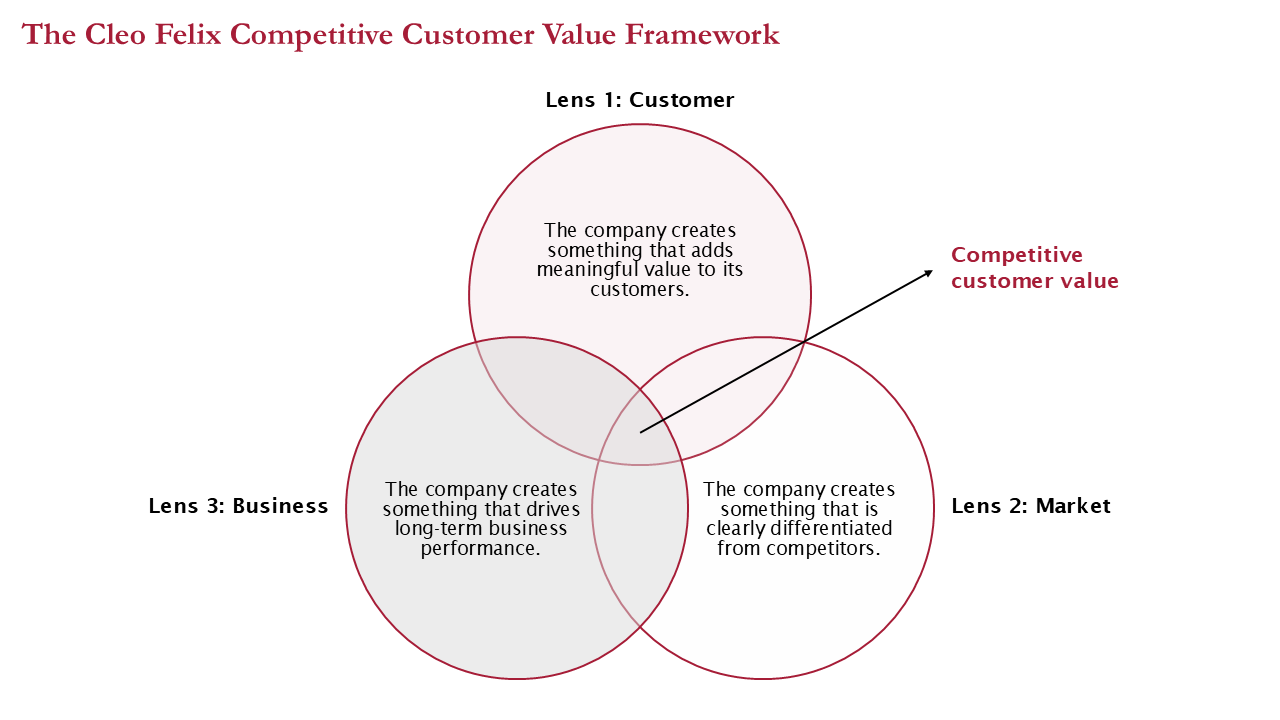
The Cleo Felix Competitive Customer Value Framework.
For a company to hit the sweet spot—that is, create truly competitive customer value—requires at least three capabilities from its leaders across the board.
Do leaders know what meaningful value the company adds to its customers?
First, through the customer lens, leaders need to have and continuously sharpen in-depth insights as to what their customers actually want, need, and desire. It may seem like a naïve question, but it's worth asking: do leaders inside the company know what value their business adds to their customers? This question goes to the heart of a company, specifically its purpose.
As Peter Drucker wrote: “The purpose of business is to create and keep a customer.” And the only way to create and keep a customer is by creating something that adds meaningful value to them. And so, any company strategy should start with a crystal-clear answer to the core question: how do we create value for our customers? Even for leaders who do not hold the pen when defining company strategy, I believe it’s every leader’s mandate to understand the world through the customer lens, and to continuously encourage the company to fine-tune its strategy in pursuit of customer value.
This capability, I’ve observed, is not only important for customer-facing leaders but, and perhaps even more importantly, it also applies to those leaders in charge of enabling functions. The leaders in charge of legal, finance, HR, and product development need a laser-sharp understanding of what value the company delivers to its customers, so they can optimally help those who work with customers daily carry that value forward.
Do leaders understand the competitive landscape in which the company aims to differentiate itself?
Second, leaders need to understand market dynamics. Effective leaders study competitors not to copy them, but to stay ahead of the curve and especially to stay relevant to their customers. Companies start losing their license to operate when their product is no longer the obvious choice for their customers. Too often, I observe leaders who are so inwardly focused that they don't realize their efforts to create something meaningful end up being a bland, unintended copy-paste of what already exists.
AI poses a major threat here, as leaders who consult their favorite LLM tool to get inspiration on how to stay relevant may end up getting answers their 101 competitors also read and appreciate as ‘unique insights’. The only way to differentiate in a meaningful way is to combine deep customer insights with the unique capabilities the company has and (perhaps more importantly) is willing to develop and sharpen.
Do leaders see what it takes to build a company that flourishes in the long-term?
Third, all efforts to move forward should be in the spirit of building a flourishing company for the long-term. Leaders seeking short-term gains without a clear hypothesis of how it will support long-term performance are at risk of burning vital resources like cash, employee morale, or—the company’s most important currency—their customers’ trust. As such, leaders need to have a solid understanding of how the company functions (not only their own divisions), and specifically the mechanics behind key metrics like revenue, profit margin, or cash flow, just to name a few.
Leading a company that creates competitive customer value is no easy feat, but the long-term rewards are substantial and worth pursuing.
Perhaps, when reading this article, you might reflect on the framework and ask yourself: where lies the first step forward for my company? Where do our leaders have a blind spot, and what do we need to resolve so we can build these capabilities in our leadership community?
Sources:
Fader, P., Hardie, B. G., & Ross, M. (2022). The customer-base audit: The first step on the journey to customer centricity. University of Pennsylvania Press.
Lafley, A. G., & Martin, R. L. (2025). Playing to Win, Expanded with Bonus HBR Articles: How Strategy Really Works. Harvard Business Press.
Osterwalder, A., Pigneur, Y., Bernarda, G., & Smith, A. (2015). Value proposition design: How to create products and services customers want. John Wiley & Sons.
Rintamäki, T., Kuusela, H., & Mitronen, L. (2007). Identifying competitive customer value propositions in retailing. Managing service quality, 17(6), 621-634.