
Why I founded a leadership development firm that hardly does any leader training.
by Tijs Besieux, PhD
A few weeks into my first job as a leadership development consultant, I witnessed something exciting: the closing ceremony of a one-year Leadership Development Program (LDP) for 150 middle managers at an insurance company. With a price tag well over $1.2 million, the program was no HR window dressing. It was not meant as ammunition for the annual report to show that the company invests in its people.
No, it was a real, substantial investment—both in cash and in participants’ time.
The program itself looked like the folks at Cirque du Soleil had a change of heart and decided to design leadership programs. All the horns and bells. A leadership model had been created upfront, clearly articulating the competencies to be honed during the program, including themes like leading change, effective conflict management, and cross-silo collaboration. The company launched and maintained a user-friendly intranet page (we’re talking about some time ago!) where the why, what, and how of the program were described and regular updates were shared with the leadership community. The program offered a rich mix of keynotes by top professors, full-day training sessions, small-group workshops, peer learning sessions, 1:1 coaching, and check-ins with the C-suite—to name a few.
This was a state-of-the-art leadership program, one the company rightfully called its “flagship leadership training.” One that I would have loved to join as a middle manager.
During the closing ceremony, the CEO gave a grand speech alongside the CHRO about how this program trained the company’s next generation of senior leaders, how it fit the overall strategy, and how it unlocked value in each person’s potential. He said: “A firm that invests in its leaders is a firm that invests in its future.” I liked these words. Lofty words, perhaps, but you could see everyone in the room smile, feeling recognized and as though they mattered—which they did.
I felt like I had uncovered a goldmine, seeing how leadership development really came to life after finishing my PhD on leadership.
That changed at the ceremony reception.
I bumped into Greg, a middle manager in the accounting department of the insurance firm. We shook hands, and I said I had just joined the consulting firm that helped design and implement the LDP. I said I was amazed to see how bringing all these efforts together created a meaningful impact for the leaders and the firm.
That’s when Greg stopped me in my tracks and said: “It’s just sad that virtually none of this will stick.”
I almost choked on my Stella Artois beer.
My first instinct, probably triggered by an overwhelming sense of defensiveness, was to think that Greg meant the program would not continue for a second cohort of middle managers.
So I asked him why he thought the leadership program would discontinue. That’s when he became quite candid.
Greg said: “No, I’m not talking about the program itself. What I mean is this.” He took out a folder with the leader competency model designed for the program. “Look at the framework here. These are the competencies this program was meant to sharpen so we could deploy them in our day-to-day work as leaders.” He started pinpointing specific areas. “Look, here, under the banner ‘Leading People,’ it says that a core competency is to regularly check in with team members to provide constructive feedback on their work. I have 22 people in my accounting team. I have on average four meetings per day in my calendar that do not involve my own team members. How on earth am I supposed to give my team members regular feedback if I rarely see them doing actual work at all?”
And he continued: “Look, here you have a banner that says ‘Leading the End-to-End Chain,’ which is all about us as middle managers being the boundary spanners between silos. Now let me ask you—am I being paid to make sure our books are in order, or am I being paid to resolve potential tension across departments? I see the importance of cross-silo collaboration. I really get it. But at the end of the day, when I have to choose where I invest my time, I’m gravitating toward making sure my accounting team is excelling in their work.”
Then he went on to a third point. Greg said: “Look, here’s the banner saying ‘Lead Change from the Front,’ which describes how we should spark change and ensure it’s executed well toward the shop floor. Again, there is no disagreeing with this. And I liked how during the program we were introduced to several frameworks and techniques for creating that spark so people would be eager to execute the change. But let me ask you this: can you clearly lay out our company strategy without using vague, almost meaningless words? Can you clearly state how a change in our governance—impacting the accounting teams—is tied to our company strategy so my people can have a clear answer to the ‘why’ of the change? I certainly cannot. So although I’d love to try to take a stab at being a better change leader, we just don’t have a crystal-clear strategy that serves as a blueprint to communicate about the why, what, and how of the change. Every time a change is initiated that impacts my team—and there are quite a lot—it feels more like an unexpected tsunami than a well-thought-out move. I’m just throwing life jackets, hoping everyone will be fine as the change hits us like a flood.”
I still remember my face turning pale; the image I had of a leadership development goldmine collapsed. My defensiveness went down, and all that was left was a feeling of embarrassment and shame. I wished I could disappear right there and then.
Because Greg was right. Very candidly, Greg voiced what perhaps many others were feeling at that time, or were about to find out sooner or later as they met the many hurdles in day-to-day work that kept them from turning these new learnings into daily habits.
Greg’s experience is not unique. Many leadership programs emphasize competence training without the willingness to change the actual environment in which the behavior should be sustained. Or, as a study published in Behavioral Sciences states it candidly: “Globally, organizations invest an estimated USD 60 billion annually in leadership development; however, the workplace application of learning is typically low, and many programs underperform or fail, resulting in wasted time and money and potential harm.” (Geerts, 2024).
To understand the fundamental mechanism that leads to this breakdown in leadership development, we must answer two questions.
First, what is the general purpose of a Leadership development program?
While there is no single definition, integrating key literature on leadership development helps to establish a purpose statement along the lines of: “Leadership development programs exist to expand people’s capacity—individually and collectively—to perform effectively in leadership roles and processes, in service of both the person’s growth and the organization’s performance.”
The word perform here is crucial. This means the goal is not to change people’s hearts and minds (although that could be a sensible means). No, the ultimate goal of leadership development programs is to change the way leaders behave, in the interest of the leader’s growth as well as the company’s performance.
Second, if durable behavior change is the ultimate purpose, then we must ask: how do we best change behavior?
Luckily, there is a wealth of research on how to realize durable behavior change. Research giants like Professor Susan Michie laid the foundations for what is now held as the general consensus around behavior change. To effectively change behavior, focus on three major forces: capability (can the person do it?), motivation (is the person willing to do it?), and environment (is the context in which the person operates conducive to the desired behavior?).
The vast majority of leadership development programs over-index on the first driver of behavior change: capability. But by overlooking much-needed changes to the environment in which the behavior occurs (either because of ignorance, or because this is much harder to achieve and less predictable to plan in a leadership program), too many leadership development firms contribute to the sector-wide breakdown in achieving effective leadership development. To illustrate, consider a recent study published in Nature Reviews Psychology, based on reviewing multiple meta-analyses of behavior change across health, environmental, and other domains. It found that trying to change what people know barely changes what they do—while changing the environment so the desired behavior becomes easier had the largest effect of any approach they examined (Albarracín, D., Fayaz-Farkhad, B. & Granados Samayoa, J.A., 2024).
This is sad, costly, but above all, it needs to be fixed. So that future Gregs won’t end up feeling abandoned once the program’s closing ceremony comes to an end.
This is exactly the problem space that Cleo Felix aims to fix. By design, our leadership program takes a big swing at realizing change in the context in which leaders operate, so that the desired leadership behavior becomes the “easy” thing to do, and perhaps one day “the way we do things around here.” Visualized below, you see the scope that Cleo Felix considers when developing customer-first leadership. Our program includes an essential step where the company’s C-suite decides on proposals developed by the company’s top 50 to remove any blockers (across Capability, Motivation, and Environment) that keep leaders from consistently displaying customer-first behavior.
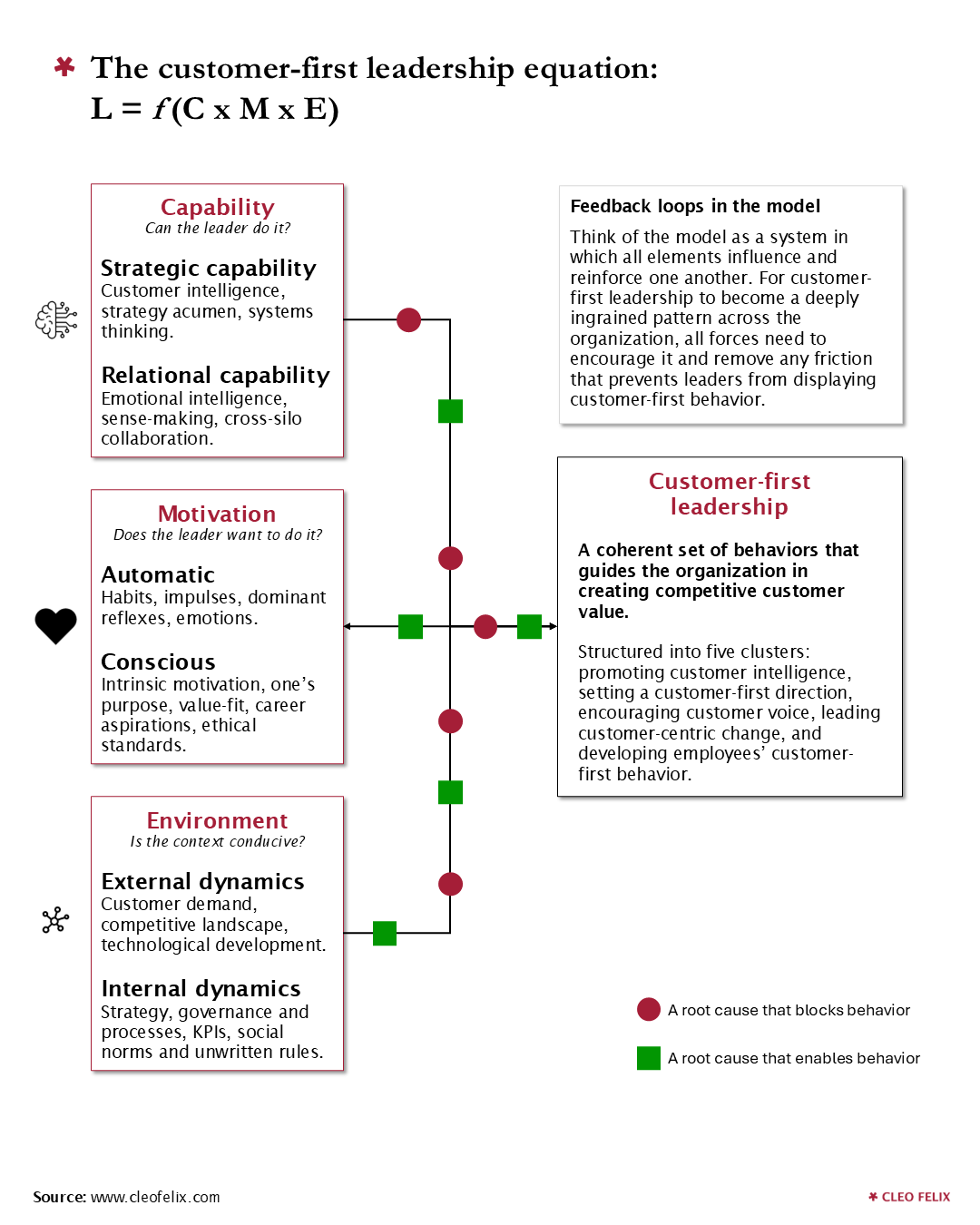
The three forces that shape leadership behavior.
Leadership development is a fantastic domain and a career worth pursuing, as enabling others to grow in service of their customers, their company, and their own growth creates beautiful moments of meaningful connection. That being said, the sector bears a huge responsibility in its current incapacity to deliver effective behavior change. And although concrete results can never be promised upfront, by shifting the pendulum more toward fixing the environment in which leaders operate instead of hosting lecture sessions on the relevance of a growth mindset, perhaps leadership development will live up to its potential. That’s what we are aiming for at Cleo Felix.
Sources:
Albarracín, D., Fayaz-Farkhad, B., & Granados Samayoa, J. A. (2024). Determinants of behaviour and their efficacy as targets of behavioural change interventions. Nature Reviews Psychology, 3(6), 377–392.
Day, D. V. (2000). Leadership development: A review in context. The Leadership Quarterly, 11(4), 581–613.
Geerts, J. M. (2024). Maximizing the impact and ROI of leadership development: A theory- and evidence-informed framework. Behavioral Sciences, 14(10), 955.
Hoch, J. E., Bommer, W. H., Dulebohn, J. H., & Wu, D. (2018). Do ethical, authentic, and servant leadership explain variance above and beyond transformational leadership? A meta-analysis. Journal of Management, 44(2), 501–529.
Leroy, H., Anisman-Razin, M., & Detert, J. (2024). Leadership development is failing us. Here’s how to fix it. MIT Sloan Management Review, 65(2), 48–53.
Mabey, C. (2013). Leadership development in organizations: Multiple discourses and diverse practice. International Journal of Management Reviews, 15(4), 359–380.
Sposato, M. (2024). Leadership training and development in the age of artificial intelligence. Development and Learning in Organizations: An International Journal, 38(4), 4–7.